
So, what do you think about Hollow Knight? Oh, you loved its charming hand-drawn art style, sprawling interconnected map, pin-sharp controls, and tight 2D side-scrolling action? Well, this bodes well. And what about Sekiro: Shadows Die Twice? Ah, you thought the focus on defensive, parry-based combat that gave its challenging encounters an almost rhythm-game-like intensity was a masterstroke? Huh, what are the odds? You clearly have excellent taste. So, can I also assume you also enjoyed the brilliant horror walking simulator Devotion and found its unique blend of meticulous world-building, intelligent storytelling, and authentic representation of Taiwanese history and culture a breath of fresh air? Wait, you haven’t played it? Well, damn, that’s a shame.
Don’t worry, you won’t be the only one. The release of Taiwanese indie studio Red Candle Games’ last title marked what was certainly the first and (probably) last time we’ll see Winnie the Pooh cause a game to be forcibly pulled from digital storefronts globally, severely harming its chances of success (Devotion has been available to purchase exclusively from the RCS website since 2021 as a result)—silly old bear. For those of you who have played it, you’ll find the same qualities here in Nine Sols that made Devotion so memorable, despite the ambitious genre shift to a hardcore action side-scroller.
Because although it’s clear that Nine Sols’ primary goal is to take a ‘why not both?’ approach to Team Cherry and From Software’s works (the team has even invited comparisons in their marketing), the studio is just as interested as it has always been in drawing from their cultural heritage to infuse their worlds and narratives with substance and vitality. Just like their previous games, it’s this third pillar that drenches Nine Sols in the secret sauce that elevates it, nudging it firmly into the upper tier of the many hopeful metroidvania pretenders and FromSoft wannabes.
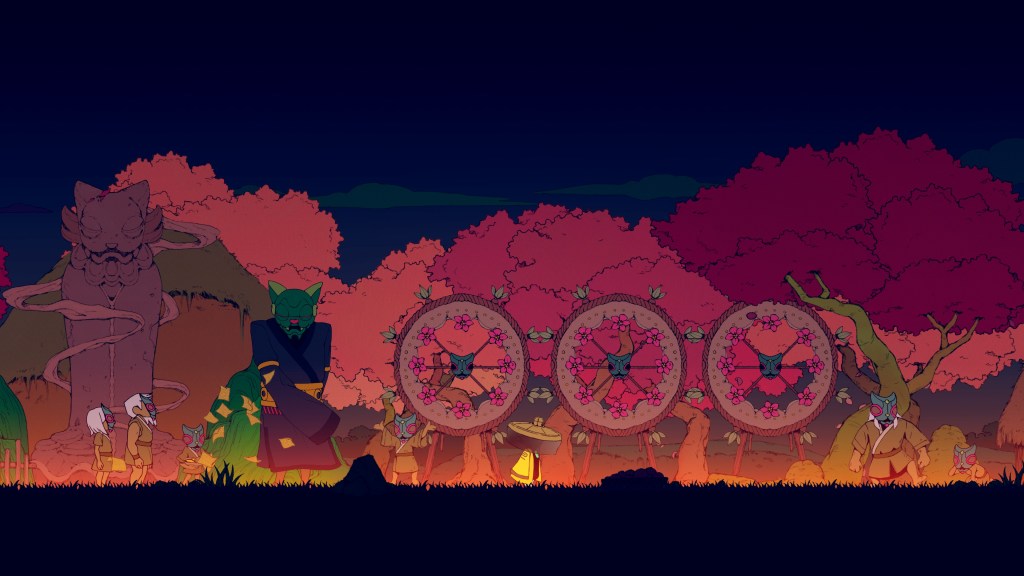
The quality is evident from the moment you boot the game too. If you have eyeballs and you enjoy looking at things, well, this might be the best thing you do with them in 2024—it’s an absolute visual masterpiece. Beautifully hand-drawn in a style described by the developers as ‘Tao-punk’, where classical East Asian art and architectural influences—richly drawn with warm, natural tones—clash with cold, hi-tech science-fiction elements—all metals and microchips. It’s a striking vision and a refreshingly authentic East Asian take on a cyberpunk future.
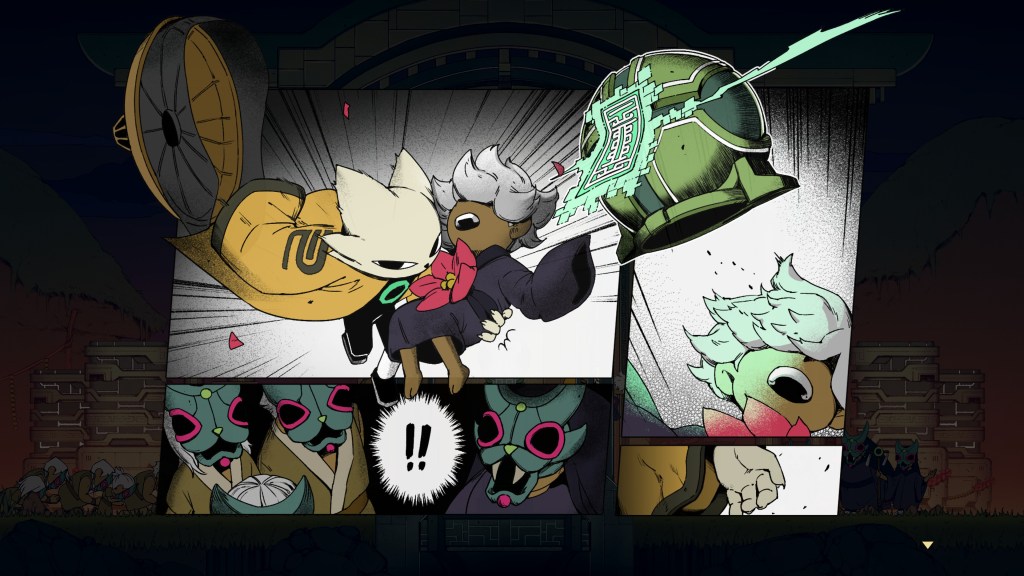
It’s not just set dressing either, as it cleverly mirrors the story’s themes of faith and mythology rubbing up against science and progress and the frictions and calamities this can cause when you throw people and society into the mix. Its world and richly detailed lore are formed from equal parts mythological tales and sci-fi dystopias, creating a flavourful and evocative backdrop that gives a weight and meaning to all the running and jumping around that you don’t typically find in a 2D platformer. The stylish manga-style cutscenes and characterful dialogue sequences will have you pausing to take in the details too, rather than hovering over the skip button.
The gameplay fundamentals are also pretty solid. The construction of the world is very reminiscent of Hollow Knight and is equally sprawling and filled to the brim with enjoyable platforming challenges, fun little puzzles, and plenty of hidden items and upgrades—all that good stuff. In classic metroidvania style, the world expands outwards over time as you gain abilities that open up new avenues of exploration. It’s possibly a little too familiar at times, depending on how many of these things you’ve played, but it is undeniably high quality and extremely polished. It’s a very good one of these, you know?
You are afforded perhaps a little too much freedom at the start, which can lead to a ponderous and unsatisfying opening few hours if you don’t tumble down the correct rabbit hole—not helped by a slightly fussy world map that requires you to find an item in each area to fill in the details (it took me four hours to find the first). But once you’ve figured out how the game flows and have a couple of abilities under your belt, it becomes a pleasure to explore. And while there isn’t too much here that will surprise you early on, the team has had fun with the design of the late game areas that are much more creative, with interesting environmental challenges and some surprising segues into different gameplay styles (there’s a bit where you pilot a mech—no joke!)
It is mostly a joy to play, but never relaxing. Because while the platforming challenges and simple environmental puzzles are pretty easygoing, the excellent Sekiro-inspired combat system requires intense focus and lightning reflexes at all times. It is possibly the finest attempt yet at removing the third dimension from a Soulslike system, taking both the big, screen-filling monster battles and intimate one-on-one duels that we all know and (mostly) love and successfully flattening them out onto a 2D plane.
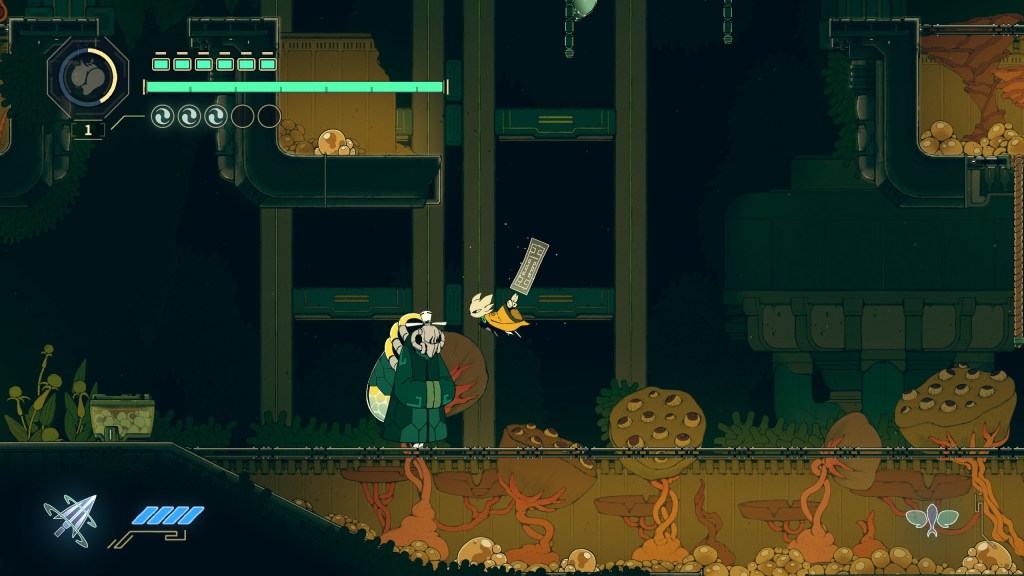
You begin with a jump, an evasive dash, and a basic three-hit sword combo (and later a charge strike), which feel great in the hands and will see off smaller bugs and other critters, but the expansive roster of larger beasties and humanoid enemies (the majority here) require you to really get to grips with its parry and riposte system. Like its inspiration, even basic enemies will make short work of you if you’re not paying attention (and even when you are, honestly). A perfectly timed tap of the shoulder button will parry a strike and grant you a ‘chi’ point, which you can then expend to pull off a talisman attack, where you whip past your foe in a cool cinematic flourish and stick them with an explosive mark that will detonate with a hold of the button, causing massive damage and outrageously gory explosions. It’s an extremely satisfying skill to master, but it can be tricky to pull off in the heat of combat—especially when fighting more than one enemy—which can lead to fights feeling a little panicked and inelegant until you’ve learned the rhythms.
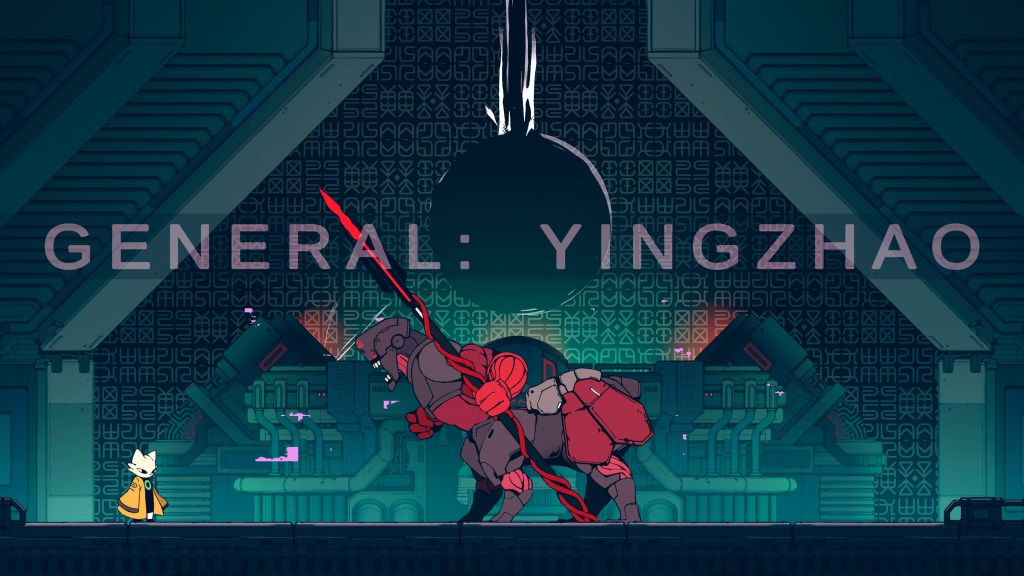
The combat is at its best when you’re going toe-to-toe with one of its dramatic and stunningly animated boss fights, even if the difficulty does register slightly too high on the makes-you-want-to-turn-yourself-inside-out-with-rage scale. Because regardless of your experience with this style of game, well, let’s just say I hope you enjoy the sight of your own arse, because it will be handed to you relentlessly. Speaking as someone who relishes a challenge, permit yourself to drop the difficulty to story mode—which is still pretty tricky—on this one.
Thankfully, there are plenty of odds-evening upgrades for you to find, with an expansive skill tree, purchasable weapon and gear improvements, and a wide selection of ‘Jades’ to equip that function a little bit (a lot) like Hollow Knight’s charms—each Jade confers a unique buff but has a cost to equip that cannot exceed your total budget. It takes perhaps a little too long for choices to become meaningful—some perks are just too useful not to equip—but the system eventually allows enough flexibility to craft a build in the hopes of avoiding yet another violent death.
On the subject of violence, it’s worth pointing out that despite the cartoony aesthetic, Nine Sols is a gruesome game and does not shy away from graphic depictions of bloodshed. It won’t be a surprise if you’ve played the team’s previous works, but just like in those games, there is a purpose and a realness to the violence that can get pretty grisly but makes sense in the context of the world. The ever-present threat of it heightens the drama, adds stakes to the surprisingly adult narrative, and draws an impactful visual contrast to the game’s often picturesque beauty, adding to the richness and depth of its storytelling tool kit.
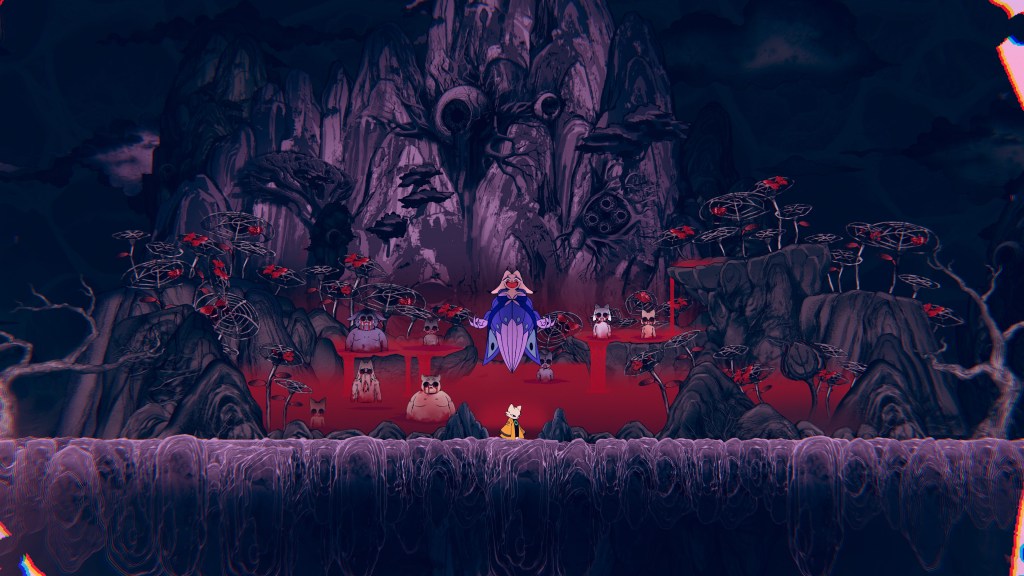
It’s not all doom and gloom, though; there are moments of real lightness and humanity in the Four Seasons Pavilion, your safe haven and home base, that you’ll revisit between exploration sessions for some welcome downtime. It’s here that you’ll spend time getting to know your rag-tag bunch of companions. Bringing back items that you can find in the world unlocks a collection of beautifully written character interactions, giving another incentive to forensically scour the game world for collectables and deepening your relationship with these characters, investing you in their continued survival. Over time, you’ll watch the pavilion turn from a clinical scientific facility into a believable makeshift family home filled with the memories of your time spent together, and watching this ramshackle family of misfits come together is genuinely touching.
You will be hard-pressed to find a review of Nine Sols that doesn’t mention Hollow Knight or Sekiro—two undisputed kings of their genres that have inspired scores of imitators. Red Candle has ambitiously lined up both in their sights and taken a respectable shot at a best-of-both-worlds title that doesn’t quite hit the extreme highs of either. But it’s the uncommon commitment to worldbuilding and the surprisingly deep and moving story that give this game its real power—as it always has been with this studio—making you care about the why of it all. Nine Sols is a worthy contender to Hollow Knight’s metroidvania crown, and the 2D Sekiro-light combat is a genuine success. But its greatest achievement is in building a world that feels worth saving, and a future you’ll want to fight for.
8/10
(A copy of Nine Sols was provided for review by Red Candle Games)
Nine Sols is available now on Steam or directly from Red Candle Games’ website


 Analogue Noise
Leave a comment