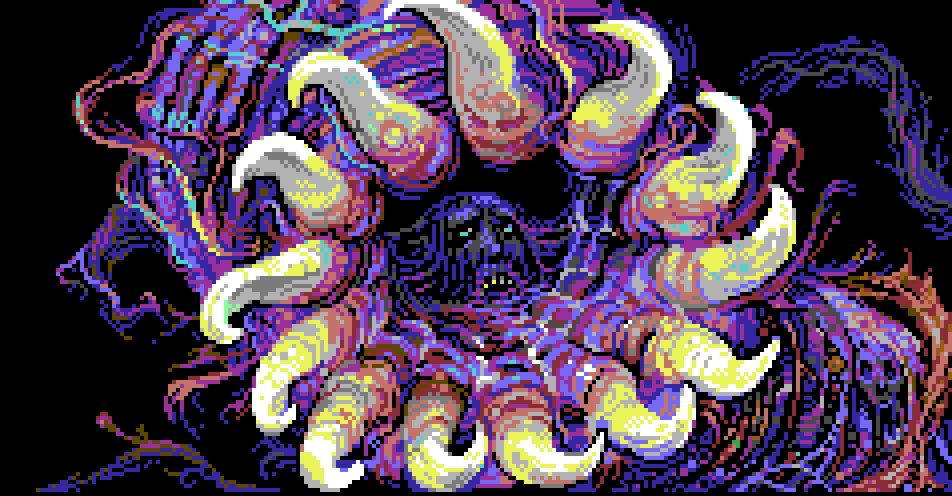
“On the wine-dark, raging seas of the Outer Isles, a lone caravel struggles against the winds and the waves…”
I awake in a dimly lit hold, mouth dry and head pounding. I hear timbers creak and crack as something strikes the hull. What’s going on? There are raised voices overhead; something is wrong. I emerge onto the deck and see the fear writ large on the faces of my crew, illuminated by flashes of lightning as a violent storm rages across the skies. Others are shouting angrily—a disagreement. I try to calm them, but I fail. Violence erupts. Suddenly, and without warning, I see enormous tentacles burst from the water, piercing the hull and snapping the masts like matchsticks. With a sickening smack, I’m sent tumbling overboard, and I hear the wretched screams of my crewmates cut short with a snap as the water’s surface greets them. It greets me too, and I see nothing but inky blackness as I’m pulled down and down beneath the waves.
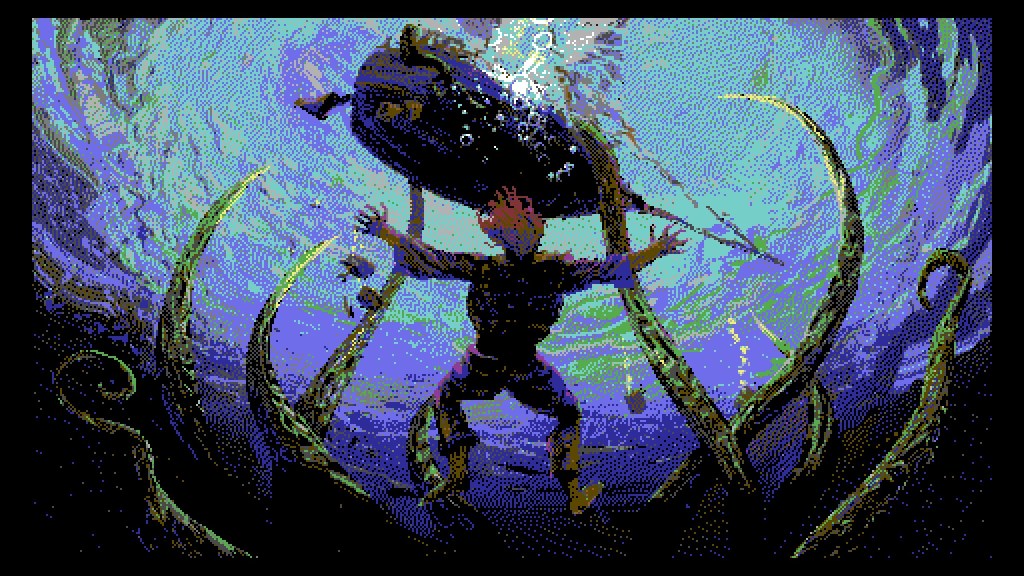
Except, I don’t actually see or hear any of it. I never did. But in my mind, I do.
SKALD: Against the Black Priory is a throwback to the classic CRPGs of the late 80s and early 90s, where images were not formed on your screen with polygons, textures, and shaders, but conjured in your mind’s eye with a handful of words and a scattering of pixels. And just like those games where your adventurous exploits, heroic deeds, and tragic failures lived as much in your imagination as they did on your display, Skald is not a showcase for cutting-edge tech, elaborate animation work, or expensive cutscenes. It’s a reminder of the potency of words and the power of images in creating stories that live long in the memory, and it’s wonderful.
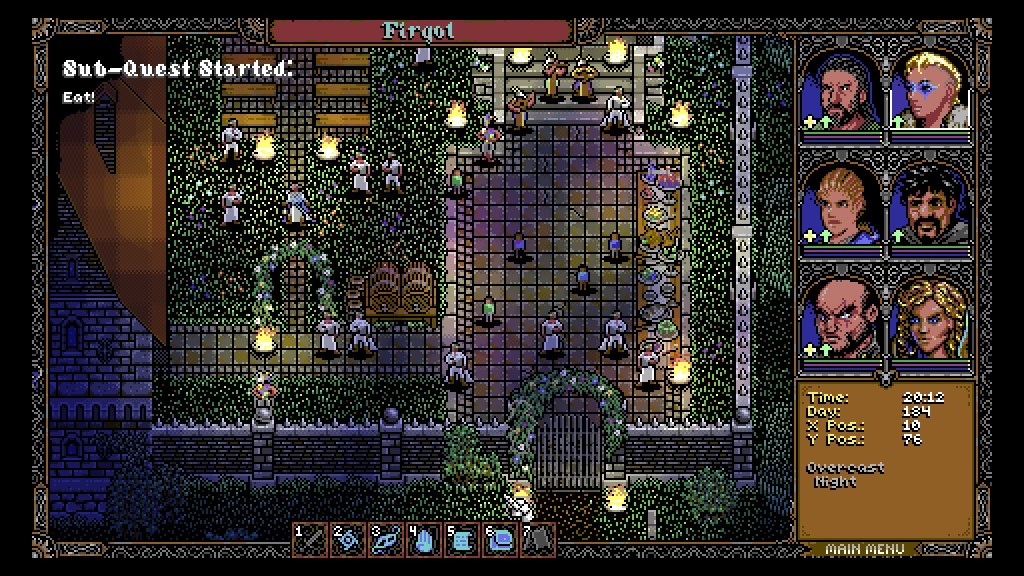
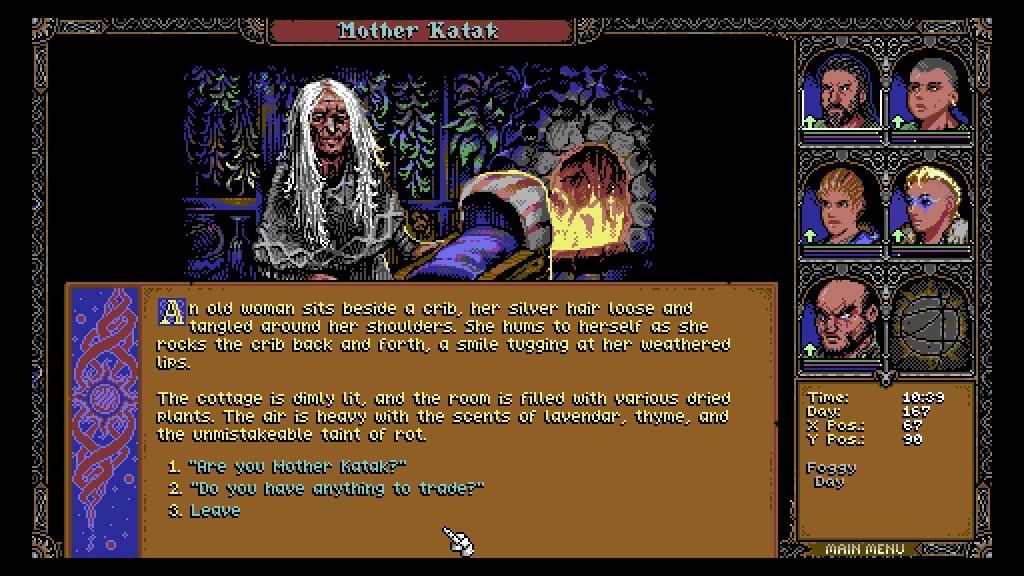
Skald invokes the distinctive aesthetics of the Commodore 64 and is a laser-targeted sniper shot to the brain of nostalgia-addled C64 heads, but really, anyone with a fondness for the classic CRPGs of the late 80s and early 90s—or the 8-bit home computer era in general—will have their nostalgia bone pretty well tickled. And even if you don’t, you’ll find that despite its rudimentary tech, the modest visuals are more than capable of drawing vivid and striking scenes. It calls to mind recent indie darling Animal Well, with its stark black backdrops punctuated by specks of colour and lurid lighting. But where that game mesmerises with its motion, Skald’s beauty lies in its stillness. The stunning pixel art tableaux that punctuate key moments breathe life and vitality into otherwise static scenes, and its environments emerge from the dark like foil scratch art panels, drawn with a thousand neon flecks from a slate of black ink, and framed like a painting by its classic Gold-Box style interface. It’s a lovely-looking thing.
You’ll begin by selecting a difficulty level from a commendably flexible set of options in a sort of ‘build-your-own-challenge’ exercise. Then, in classic RPG style, you’ll create a character, choosing from nine distinct classes and a background story that affects your starting stats, and a set of skills and feats that determine how your character functions in combat, exploration, and dialogue sequences. You’re free to whip up a smart-talking, stabby little rogue or a dumb-as-a-rock axe-wielding oaf at your preference, and there’s just enough elasticity to make your choices feel meaningful without becoming overwhelming.
That same philosophy extends to the gameplay too. For time-poor players eyeing up others joyously smoking all 150 hours of Baldur’s Gate 3 like Gandalf with a bag of pipe-weed (LOTR on the brain, apologies), or those of you who have been scared away by its fiddly controls or bewildering depth, well, then get your pipe out because here’s your gateway drug, and it’s Bilbo’s eleventy-first birthday (sorry). Skald is a celebration of the classic-style CRPG but packaged in a streamlined, accessible format that doesn’t require too much energy from a tired brain and will not demand your every waking minute for weeks on end. It’s an unexpectedly breezy experience for a title that, on the surface, resembles the brilliant but notoriously stodgy CRPG classics of yesteryear. Make no mistake, Skald is a nostalgia play, but it’s an unusually forward-looking one, with one sabaton firmly planted in contemporary game design ideas. It’s a fast-moving and player-friendly experience, even when compared to many of its modern-day CRPG peers. Skald is a great RPG, but it’s also remarkably sprightly and really moreish.
You’ll explore its fields, towns, caves, and dungeons in a top-down, tile-based system reminiscent of the classic Ultima games, where your little avatar will bob along grid-based maps one tile at a time, foraging for supplies, hunting for treasure, and scouting for enemies. There is no interact button, so to collect items, open treasure chests, or chat with NPCs, you just activate them with a simple nudge of the directional button. There’s also a simple but satisfying stealth system based on light and shadow, which ties into some impressive per-pixel lighting effects, allowing you to get the drop on enemies or even avoid them entirely if you’d prefer. Your little sprite will occasionally snag on the environment, and it can be tricky to parse the gritty textures for walkable tiles, but bouncing around the world is enjoyably snappy, and it gives the exploration a nice pacey feel. You can play with either a mouse or keyboard (or both), and the controls are simple enough to be played mostly single-handedly, freeing up the other for gripping your flagon of mead. You’d be forgiven for assuming Skald is a fusty relic for old people, but like your era-appropriate beverage of choice, it all goes down very smoothly, with an almost mobile-game-like playability that belies its old-school sensibilities.
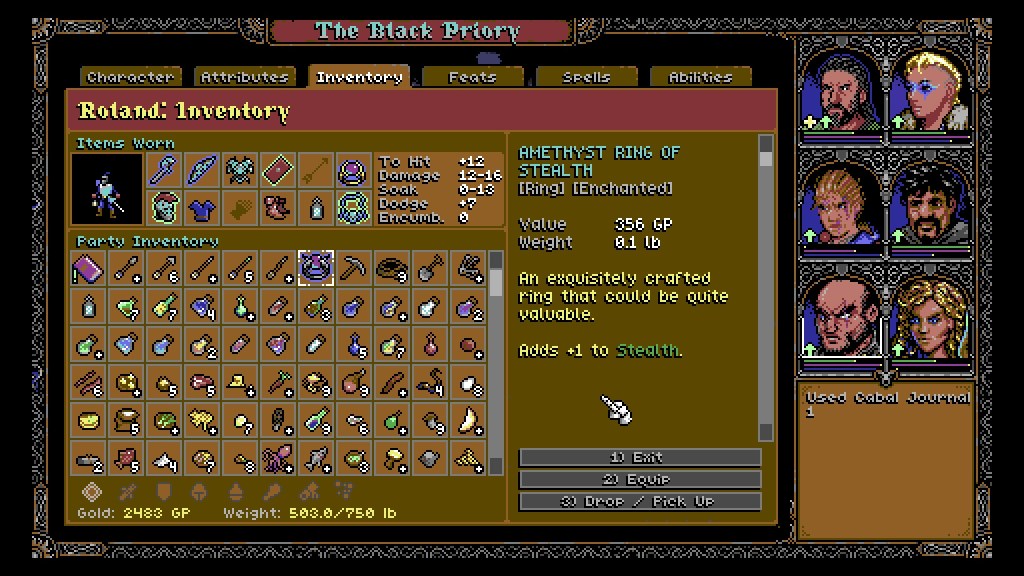
Punctuating your exploration are Baldur’s Gate 3 style skill checks, decided by visible dice rolls. Outcomes are based on the skills and abilities of your current party leader, so you’re just as likely to fail as you are to succeed when, for example, you might run into a lore check with your intellectually challenged warrior. The consequences are never dire, however (for you, anyway), and you’ll have fun rolling with the punches.
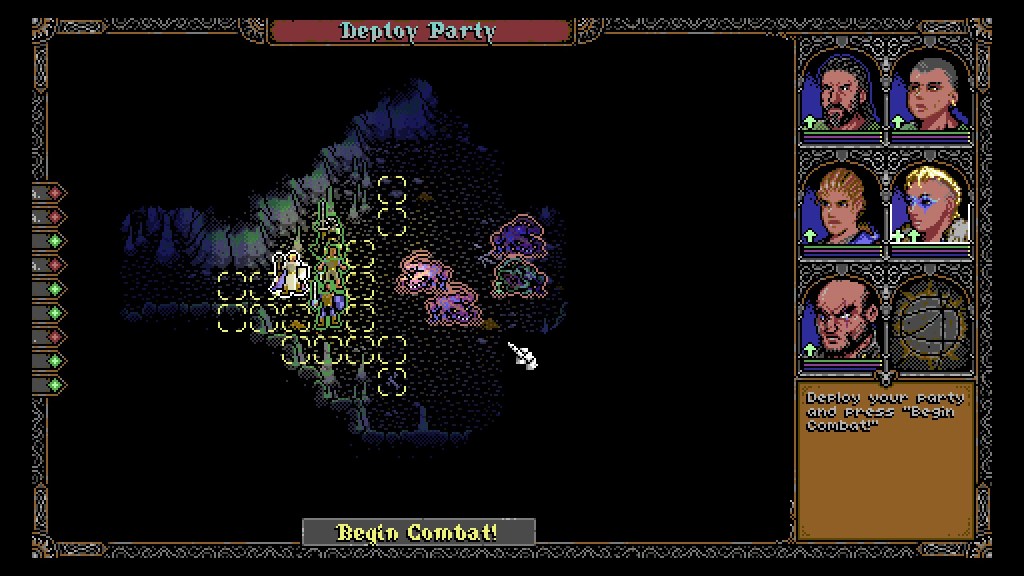
You’ll enjoy dishing out the punches too in its crunchy, fast-paced combat system, and there’s no need to pour over a one-hundred-page manual to get to grips with the rules. Encounters begin with a deployment phase allowing you to place your party around a grid in preparation for D&D-like turn-based scraps, often in tight spaces where clever positioning is paramount—hiding your rogue away to set up back-stabs, clearing pathways for charging warriors, and surrounding your mages with less squishy bodies—offering a satisfying spacial puzzle element to an otherwise traditional formula. You’ll need to make smart use of a fairly limited toolset to begin with—things start perhaps a little too simply—but as your characters level up and you fill out your party (eventually six strong), your tactical options eventually ramp up. The combat never quite reaches the heights of tactical complexity as the very best of the genre, but it’s a fair trade-off to maintain its brisk pace and keep you moving.
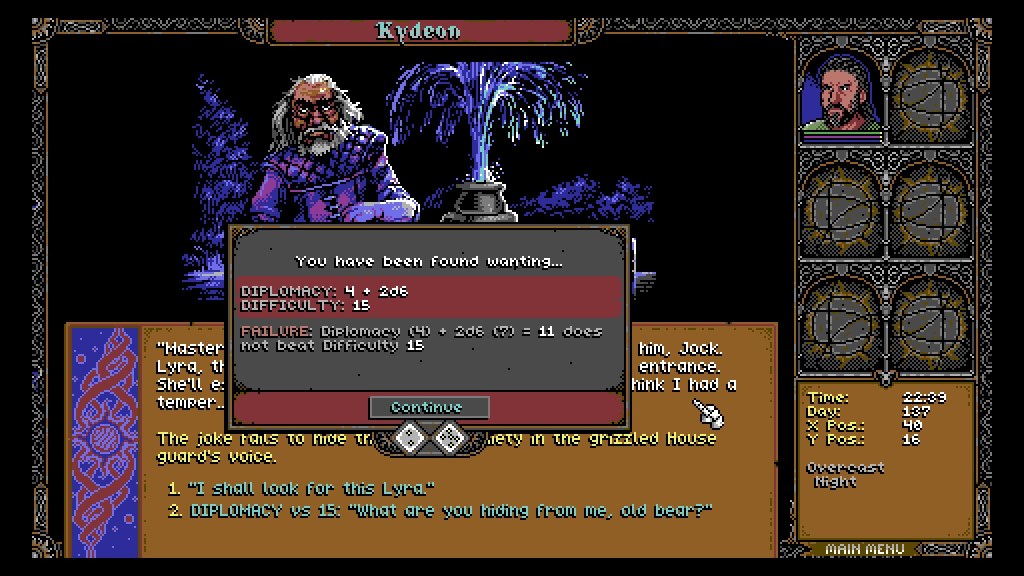
Hats off to the writers too who have really put a shift in; words are everywhere in Skald, filling the silence of its spartan soundscapes, plugging the gaps in its minimalist visual design, giving life and personality to its characters and spaces, driving the choose-your-own-adventure style dialogue trees, and heightening the drama of climactic story moments. This is good old-fashioned wordsmithing that has punch and pace but knows when to luxuriate in some flowery prose. There are some unfortunate typos that will hopefully get cleaned up, and it is a little devoid of humour and lightness, but it goes hand-in-hand with the moody SID-chip-inspired soundtrack (look it up young’uns) in building Skald’s thick horror-tinged atmosphere. Because despite the Tolkien-esque wizards and warriors theme you might expect, Skald takes more inspiration from the works of H.P. Lovecraft and contemporary horror media (there’s more than a hint of A24 here) for its story and setting.
After your unfortunate boating incident, you wake up alone, marooned on a cursed island with no party or equipment. You have a main quest to fulfil: somewhere on the island is a missing woman and childhood friend who needs your help. But something has awoken on the Isles, and a madness is spreading. Reassuringly, it’s not just you having a shocker—no one is having a good time on the Outer Isles. Everyone you encounter has met with tragedy (or is teetering on the edge of one), and invariably they will need your help. Thankfully, there’s a welcome focus on quality questing rather than quantity—you won’t meet any numerically obsessed musophobes here—and with no map markers to guide you, the pleasingly cryptic quest descriptions will see your party setting out into the unknown, led by your choices, curiosity, and intuition, and there are often multiple solutions to problems. In the second act, you’re tasked with taking down the leaders of three factions across a city under siege. You could track down all three and kill them, but some cursory poking around will expose a fierce rivalry between the camps, and with some careful manoeuvring, you might just find a way to exploit the bubbling tension…
The quality of the quest design holds up throughout, but the game is something of a content pyramid—broad and non-linear at the start, before gradually funnelling you towards the conclusion. It perhaps doesn’t quite stick the landing with a (seemingly) strictly linear ending sequence that is suitably moody and Lovecraftian, but does feel a little anticlimactic after all its choice-driven role-playing shenanigans. It’s a shame that it concludes on a bit of a bum note, but the ending is not the thing that will stay with me. Skald may not have the life-destroying longevity, cinematic presentation, or fathomless depth of a Baldur’s Gate 3. It isn’t a genre-defining masterpiece—not quite. But for a game made by a few people, rather than five hundred, it gives you a full-fat party-based RPG experience that gets remarkably close.
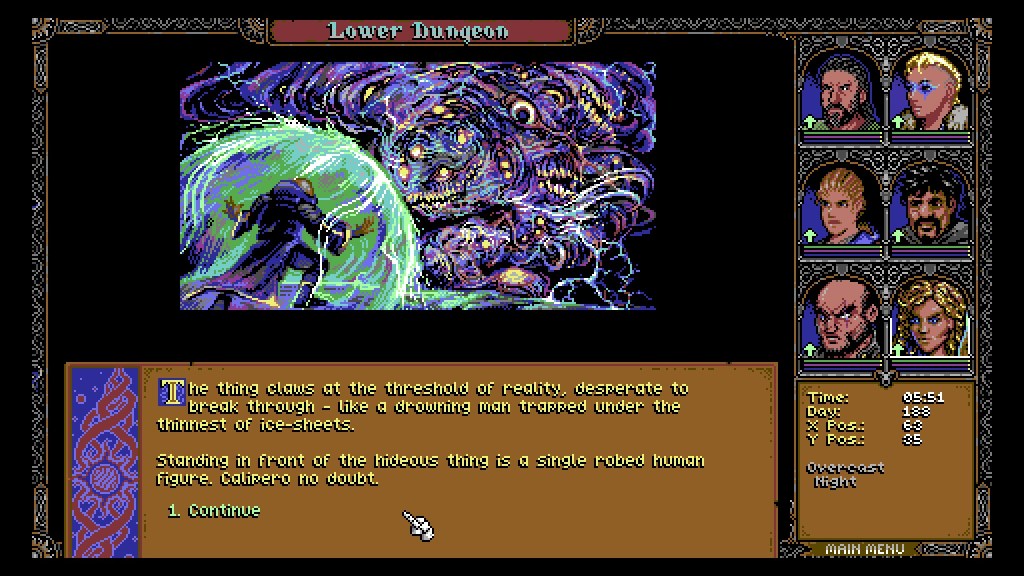
As clueless, greedy corporate execs are drooling over artificial intelligence as the new frontier in cutting-edge narrative design, Skald is a timely reminder that the written word, when wielded artfully by a talented writer, has the power to really lift a game to greater heights and to fire the imagination. In a time of unsustainable graphical fidelity, demand for mirror-sheen polish, and triple-A excess, it’s also a fine illustration of how smart design and a striking art style can create an experience that looms large in the mind and transcends its modest scope. While astronomical game budgets, achingly long development cycles, and reckless business decisions have led to an uncertain future for our industry, and a suggestion that maybe we’ve gone a little too far—alongside many recent indie peers with an eye fixed firmly on gaming’s past—Skald is a helpful reminder that, sometimes, good ideas about how we move forward can be found by looking back.
8/10
(A copy of SKALD: Against the Black Priory was provided for review by Raw Fury)
SKALD: Against the Black Priory is available on Steam from May 30th 2024


 Analogue Noise
Leave a comment