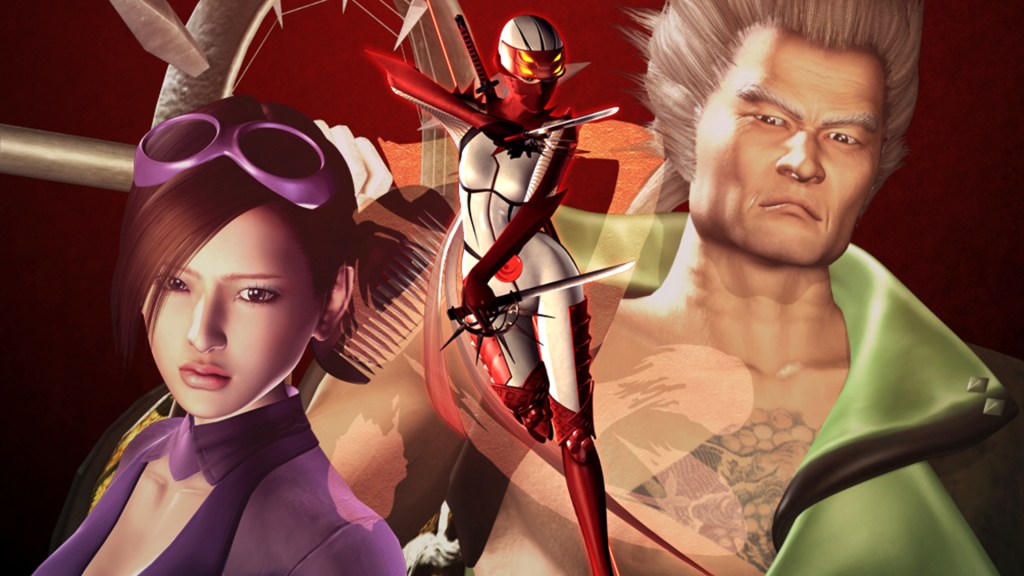
This season, I’ll be looking at a collection of lesser-known PlayStation 2 character action games through a modern lens. Spoilers for what follows below, I suppose, but wow! What a start.
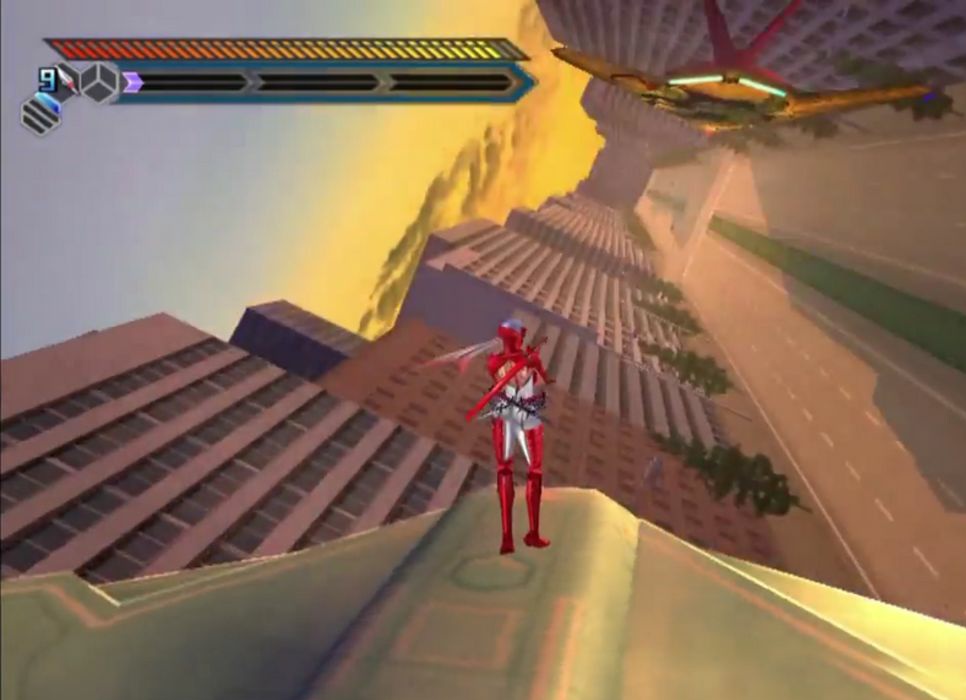
If you’ve played the opening scene of Platinum Games Wii-U classic, Bayonetta 2—a breathless brawl on the back of a moving fighter jet as it weaves through towering skyscrapers—you’re unlikely to forget it. It’s a spectacular backdrop for the gloriously OTT gameplay showboating that’s become synonymous with the character-action genre ever since Devil May Cry turned all the dials up to eleven in 2001. What you may not know (and was certainly news to me on starting this game) is that it’s also an homage to the opening level of a little-known 2003 PlayStation 2 action game from SEGA. The Bayonetta games are chock full of references to classic SEGA titles, but this one is a particularly deep cut. Nightshade was doomed to inevitable obscurity after receiving a critical hammering (68%, according to Metacritic) and releasing in very close proximity to the unfortunately similar-looking Ninja Gaiden in the West. It sold poorly, disappeared into the infinite black hole of the PS2’s vast library, and was largely forgotten.
Nightshade is a direct sequel to the 2002 Shinobi series reboot, which had a slightly more positive reception. But for most players and critics, Shinobi’s simple but demanding gameplay, insta-fail death pits, and lack of mid-level checkpoints were seen as outdated design relics best left in the past. The game didn’t make much of a splash, but the combination was like catnip for a certain type of action game sicko, presenting the kind of hardcore challenge of precision, reflexes, and dexterity that was mostly absent in the slightly spongy early days of 3D action game development. Shinobi is an incredibly challenging game and not one I’d recommend for everyone, but it is considered an arcade-action masterpiece by many genre aficionados, including myself. What a treat then to discover that Nightshade takes everything good about Shinobi and thoughtfully expands upon it, keeping the brutal level of challenge intact but splitting stages into more manageable chunks with checkpoints to ease the frustration of repeated deaths. It makes for a game that can be recommended unequivocally and without caveats—every bit the equal of its predecessor, and a game design masterclass to be counted among the very best 3D action games on the system.
What may have felt simplistic and dated to critics at the time of release feels like a revelation today, where a typical character-action-style game will arrive stuffed like a turkey with all the usual triple-A trimmings. In fact, the genre had already accumulated layers of excess by 2003 (the ubiquitous RPG systems creep), and rather than adopting the more extravagant design of its contemporaries, Nightshade stays true to the style of Shinobi and strips everything away to present a pure arcade-style action experience in keeping with the series’ roots. There are no RPG elements, no skill trees, no stats or weapon loadouts; you begin and end the game with the same skill set, and success is earned through your mastery of the mechanics.

You also won’t find the kind of DMC-style freeform stylish combat that gives rise to all those highly gif-able YouTube combo videos here; the move set is small, functional, and streamlined. It’s combat design by way of a scalpel, and there’s a beautiful elegance in its minimalism. Rather than feeling shallow, the game is laser-focused, and depth comes from the manipulation of a highly manoeuvrable character in 3D space, where skilful movement between and around enemies is the key to success rather than the execution of combos or attack pattern memorisation. It feels pin-sharp in the hand with an almost one-to-one relationship between the pad and your character on screen, with zero friction and not a hint of animation priority—almost as if you’re manipulating the code directly. Fans of cinematic action games are not well catered for here; this is a very mechanics-focused game where visual splendour firmly takes a backseat to responsive control.
It does, however, make one delightful concession to action movie cool in the signature “Tate” (tah-tay) system. Like in Shinobi: Cut an enemy down, and they remain suspended in a static death animation while a metre begins rapidly ticking down. Dash to another enemy in time and you can begin chaining kills, with the blade becoming more powerful with each strike. The goal is to pick off the weaker targets in quick succession, charging the blade for one hit kills on stronger enemies; encounters can and should be over in seconds when you’re playing well. Clear the room before the metre drains and gameplay pauses for a cinematic flourish as frozen enemies split in half from invisible wounds, then simultaneously tumble to the ground in a satisfying slump. The system comes into its own in some brilliant boss fights that play out more like complex platforming challenges than a traditional scrap, requiring you to dodge and weave among smaller enemies, taking them out to power up the blade to deliver devastating charged attacks on the boss. Most bosses will shrug off normal attacks, but they can be cleared with one or two fully charged sword strikes. It’s a brilliant mechanic that is unique to this series and makes for some incredibly satisfying moments when you pull it off.
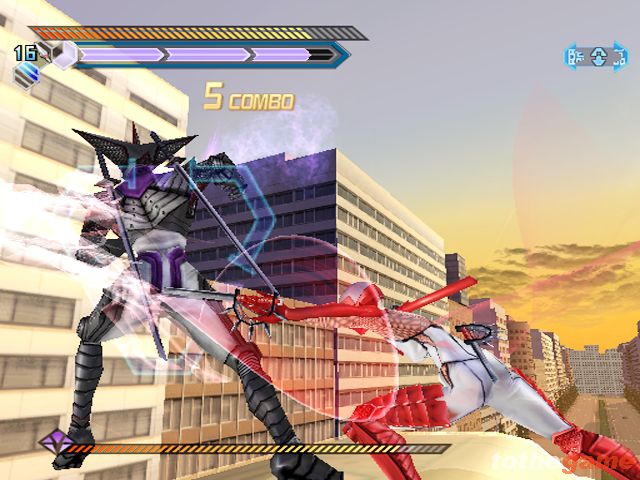
Another unique element of this game is that outside of boss fights and the obligatory locked-in combat challenges, most enemies are fairly static and don’t put up much of a fight. They exist primarily as level design features to guide or impede your progress through what is the game’s real threat—the environment. More specifically, bottomless death pits that instantly kill and dump you unceremoniously back at the last checkpoint. They’re used sparingly in early levels, but later stages feature almost as much gaping void as solid ground. It sounds horrible in theory but is thrilling in practice, and it is the lynchpin of the level design that leads to yet another unique feature of this game: when playing well, you’ll spend more time in the air than you do on the ground.
The ever-escalating difficulty curve increasingly asks you to navigate environments using a combination of double jumps, wall runs, and air dashes, with nothing beneath you but certain death. While airborne, striking an enemy resets your jump and dash abilities, allowing (and often requiring) you to bounce between multiple enemies without touching the ground. (Think a 3D version of Ori and the Blind Forest’s bash mechanic.) It’s essential in early levels for clearing certain encounters and snagging some of the harder-to-reach collectables, but the later stages ask you to master these mechanics just to navigate their spaces, where one single slip—a simple misdirected dash or poorly-timed attack—will see you plummet to your death. A handful of particularly memorable stages require you to perform these aerial gymnastics on the back of moving vehicles, contending with exploding trucks or missile fire on top of dealing with regular enemies and the threat of falling to your doom. It’s a lot to contend with and will be too much for some, but the game is never cheap or unfair. It gives you all the tools you need to succeed and simply asks that you execute flawlessly. It’s bastard hard, but unbelievably exhilarating.
All of this combines to give Nightshade the feel of a precision platformer rather than a brawler, and one that feels like a true extension of the side-scrolling classics that inspired it. The development team was comprised of staff members from the original Shinobi arcade titles, and the weight of experience from SEGA’s veteran developers is keenly felt in every facet of its razor-sharp design. Coupled with its brilliant predecessor, these two games are possibly the closest thing we’ve ever had to a true 3D incarnation of the 2D action classics of the 8 and 16-bit era, and I mean that in the most complimentary way possible. Together, they form a formidable duo of arcade action perfection, misunderstood and underappreciated in their time, and deserving of a better legacy. If you’re someone who appreciates good game design and relishes a challenge, both of these games are essential. Go play them.




 Analogue Noise
Leave a comment